THE ORGAN - Fact
and Speculation
|
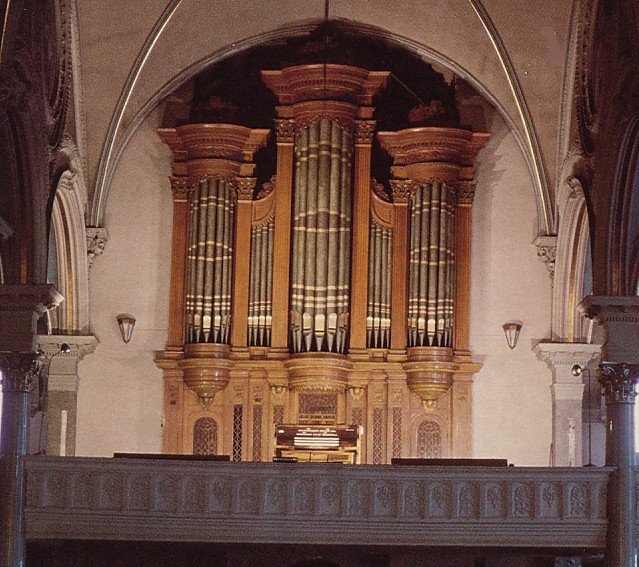
A large and unusual organ
was built in 1861 by William F. Mohr and installed in the
St. Mary's gallery as a two-manual organ with a detached,
reversed console. Thus, the organist sat with the organ
behind him and peered down the nave of the church toward the
chancel. The appearance of a mounted five-rank Cornet among
the Great stops is rare, perhaps unique, in American organs
of the period. Circa 1896, after Mohr's death, Garret House
of Buffalo, who was Mohr's last employer, added a third
manual division, made a few a modest tonal changes, and
rebuilt the wind system. His work included moving the
console further from the main case of the organ, and
rearranging it so that the organist would face the case,
rather than the chancel. This change necessitated reversing
the order of the pipes, for the relationship of the keyboard
to the action and pipes had been inverted by turning the
console. Whether this was accomplished by constructing
all-new chests in 1896, or simply by turning the existing
chests 180 degrees, is uncertain. House increased the manual
compass from 56 to 61 notes, which would seem to imply that
he built new chests for the existing divisions. Examination
of the three chests in the organ was not entirely
conclusive, for those serving the two older divisions
appeared to be of somewhat different construction than the
choir chest. Yet, there was no immediate evidence that
channels, pallets, and action for five additional notes had
been added.
|
Several historians speculate that all
of the chests date from the House rebuild, for the old chests would
have been used, even though they were of 56-note compass, if they had
been serviceable. This further led to speculation that the organ
originally may have had chests of a design differing from typical
pallet-and-slider chests, such as the "cone-valve" or "pipe-valve"
tracker chests common in German organs of the time. Such chests may
have been preferred by Mohr for the same reasons that he elected to
provide the instrument with a wind system of late European design,
atypical in American organs.
In 1951, Jacob Gerger of Philadelphia
replaced the tracker action with electropneumatic pulldown actions
and a new console, and moved pipes around. The action had failed by
the early 1970s, and the Great action was patched by David Snyder.
The pneumatic leather of the supply-house actions was completely
rotted in the Swell when the organ was examined before
removal.
William Mohr's surviving instrument
was rescued from sure extinction on June 30, 1982, when Organ
Historical Society member and organ builder Rubin Frels of Victoria,
Texas, attended an auction at St. Mary's Roman Catholic Church in
Buffalo and successfully bid against another party who had intended
to acquire the instrument solely for its facade, which he said he had
hoped to incorporate into the serving bar of a nightclub. Mr. Frels
paid $10,000 to save the instrument from that fate, and then bore the
same expense to hire a crew of six (and, at times, up to a dozen), to
disassemble and pack the instrument between March 16 and 24,1982, and
to transport it to Victoria in May. Its dimensions had been 34 feet
tall, 21 feet wide, and 17 feet deep. The organ is currently in
storage in Round Top Texas (between Austin and Houston off Rte 290).
Round top is the location of the International Festival-Institute, a
summer festival of concerts ranging from chamber music to major
symphonic works. There are plans to build a special
auditorium-concert hall to house the organ.

With the pews removed, the floor
of St. Mary's
became filled with the parts of the Mohr organ as it was
dismantled.
Members of the crew who removed
the organ included Amory Atkins, Ted Blankenship, Whitney Fletcher,
Rubin Frels, Sebastian Houseman, Dana Hull, Alan Laufman, Shawn
McKenna, Bill Van Pelt and volunteers David Snyder and Dr. Lydia
Fish. Ted Blankenship recorded many details of the organ, including
scales for many ranks, reported here:
1861 William F. Mohr,
Buffalo ca. 1896
Garret House, Buffalo, enlargement
1951 Jacob Gerger, Philadelphia, electrification
compiled by Ted Blankenship and David Snyder,
stop nomenclature from Gerger console
|
GREAT 61
notes
16' Principal om
Mohr
8' Principal om
Mohr
8' Gedeekt sw basses
from Mohr 8'Gt. St. Diap., trebles from House 16' Sw.
Bourdon
8' Wald Flute ow from
TC, sw basses, House
8' Viola da Gamba om.,
12 Violin Diapason basses by Mohr, trebles by Gerger
or House
4' Principal om
Mohr
4' Gemshorn om
Mohr
2 ' Na2iard om.
Mohr
2' Geigen Octave om
Mohr
III-V Cornet Mohr,
mounted from tc, sm & om, bass from
Mohr
Sw. Mixture moved by
House
HI-IV Mixture C'-B14
om Mohr, C`-up spm replacements
8' Trumpet mr, 12
basses by Mohr, rest 1896? replacements
Chimes
CHOIR 61 notes,
entire division by House
8' Gelgen
Principal om
8' Viola d'Amour
om
8' Dulciana
om
S' Melodia ow from
tc
4' Fugara
om
4' Flute d'Amour om,
wide scale
2' Piccolo
om
8' Clarinet mr,
faggotto basses
|
SWELL 61
notes
16' Lieblich
Gedeekt 29 sw from House Sw. 16' Bourdon, rest
sm, from Mohr 8' Gt.
St. Diap., Gerger electric unit chest
8' Principal om
Mohr
8' Salicional om
Gerger, on 16' slider
8' Vox Celeste om
House Salicional 8' Stopped Diapason from 16'
unit
8' Rohr Flute m
chimney flute, Mohr
8' Aeoline om Mohr,
old "Clarabella," 12 sw basses
4' Octave om.
Mohr
4' Flute Harmonic om
House
4' Gedeckt from 16'
unit
2 ' Nazard from 16'
unit
2' Flautino tapered om
Mohr
III Dolce Cornet om
House
8' Oboe
House
8' Cornopean mr,
probably Gerger, on added slider
PEDAL 32-note
clavier, 30-note chests extended by House from original
25-note chests by Mohr
32' Resultant
from dbI open
16' Double Open
Diapason ow Gerger (M611er pipes on unit
chest)
10' Bourdon ow Mohr,
originally in Great, altered, replaces Mohr 8'
ow
16' Dulciana ow
Mohr
16' Lieblich Gedeckt,
swell unit
8' Gedeckt swell
unit
8' Open Flute from 16'
pedal unit
4' Flute Gedeckt,
swell unit
2' Piccolo swell
unit
16' Trombone ow reed
Mohr
|
COUPLERS Gerger
console
|
Sw. to Gt. 16, 8,
4
Ch. to Gt. 16, 8,
4
Sw to Ch. 16, 8,
4
Gt. 16, 4
Sw. 16, 4
Ch. 16,4
|
Gt. to Ped. 8,
Rev
Sw. to Ped. 8,
4
Ch. to Ped. 8
5 pistons ea.
manual
5 General
pistons
Full Organ
|
Technical information
extracted from material written by Bill Van Pelt and David
Snyder.
Photographs c. Bill Van Pelt and
c. Lydia Fish/Niagara Frontier Folklore Archives
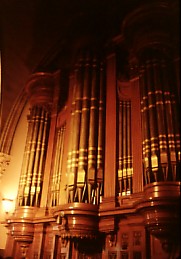
close up of
case
|
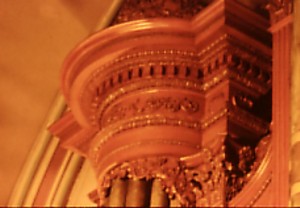
case
detail
|
back to St.
Mary's main page