Nancy Piatkowski .gif)
Nancy Piatkowski
Grounded in community-based, participant-observation and extensive research, this paper will examine the overall place of the temporary devotional altar in defining the culture of immigrant /marginal peoples within the majority group.In studying folk religion in the cultures of immigrant/minority (border) people one common element appears: the temporary devotional altar. Often standing outside the doctrinal or liturgical framework of the "official church", altars appear among many ethnic groups in their homes, community, or church settings.. While temporary altars have a prominent role in Roman Catholic ethnic churches such as the Polish custom of a Good Friday Tomb, May Altars in honor of the Blessed Virgin Mary, and in syncretic religions such as Santeria, Voodoo, and the Native Church of North America, this paper will make specific reference to the Sicilian St. Joseph's Day, the Mexican Los Días de los Muertos and the Serbian Slava (patron saint) celebration.
The altar stands as a crossing point between the sacred and the profane as the people themselves often stand on the border with the majority culture. The altar is set up on a particular day, in a specific place, for a specific celebration often known only to the group and thus hidden from the general population. The altar acts as a powerful means of group identification and cultural bonding if even for a short period of time. Those "doing" the altar are aware that others of similar backgrounds are also "doing" altars.
The ethnic consciousness of an immigrant group results from its collective experience in the new environment being interpreted in the light of the original culture. This consciousness becomes prominent only when people stress their distinctiveness which includes the material culture and beliefs about their distinctiveness. The ethnic self-consciousness of a community and the image it holds of another community will derive from the fact that there is a border between them.
This sets up a "we vs they" dichotomy. We can only be built up through a comparison (contraposition) with a certain they and what borders are set up between the groups be they political or psychological (Porshnev 1978). Knowledge shared within the group but not with outsiders also contributes to this sense of "we vs they". Many times the native language is used when outsiders are present to transmit information from one person to another in the group that they do not want the outsider to understand.
Generally we can say that a person can be considered a member of an ethnic group if first, they consider themselves to be a member of the ethnic group and second, if all other persons who consider themselves to be members of the ethnic group consider that person to be a member.
We can ask the question then-- what is the place of devotional altars in the identity of the people? Religious beliefs are always common to a specific group. They are not an individual phenomenon but what gives the group its unity. Individuals within the group feel bound to each other by reason of the common belief. This belief is most often translated into what is referred to as "church" usually identifiable by a specific denomination and name but in some cases may be popular practices that are not "baptized" by the official church.
Don Yoder in his article "Toward a Definition of Folk Religion" in Discovering American Folklife: Studies in Ethnic, Religious and Regional Cultures, defines FOLK RELIGION as "the totality of all these views and practices of religion that exist among the people apart from and alongside the strictly theological and liturgical forms of the official religion." Folk religion has been described as the "Little Tradition", a syncretistic mixture that blends "elements from the great tradition into a body of pre-existent beliefs and practices" (Mitchell). This definition is often applied to the beliefs of people who are psychologically or physically isolated from major urban centers or main stream religion for one reason or another. Folk religion helps people deal with the day to day aspects of life that "the great tradition" offers no immediate solution. Folk religion ordinarily deals with six aspects of life: food, health and illness, life cycle, the dead, and the future. Folk religion gives people micro-rituals and symbols that help them deal with the aggravations of everyday life. They are not, as some believe, just superstitious practices but a way for someone to act on behalf of another. A person can respond to a need in a direct, personal way unencumbered by official doctrine or cult practices.
Taking this definition I have defined FOLK RELIGION simply as the non-liturgical expression of religion within a particular ethnic community. The non-liturgical expression is the type of faith expression that takes place outside the formal church worship services even though some of the ritual may be carried out by the ordained clergy. These practices are used by members of the group as a direct means of identification with other members of the group.
My original research was to explore the relationship between religious practices reenforcing ethnicity and ethnicity reenforcing religious practices using the St. Joseph's Table as a focus. However as I continued the background reading in culture and ethnicity as well as on saints and devotions, I began to examine the historical and cultural makeup of certain ethnic groups and how devotion to a particular saint or a holyday may reflect the emotional needs of the people. What began to develop has resulted in first of all an examination of the St. Joseph's Table from several different aspects- the devotional, the social and the cultural. I then began to look critically at experiences of the Slava I had while associated with local Serbian-Americans and Canadians. This association, (which goes back over 25 years) together with the more recent interest in Los Dias de Los Muertos, has shown that the folk expression of religion is a part of a continuous religious/ethnic identity with deep roots in family tradition. A major part of an ethnic group's identity and its reinforcement comes through the telling of "their story" to succeeding generations. The St. Joseph'sTable, the Slava and Los Dias de Los Muertos serve as a way of gathering the "tribe" to tell the "tribal" story beginning with who came first, who was left behind, who went back and why they came to be where they are. This telling of the story also extends to the stories of churches, social clubs and institutions.
What has struck me most in looking at these traditions is, that while they are very different, they are similar in their forum and function. Briefly--
-- The St. Joseph's Table is done by Sicilians and Sicilian-Americans in fulfilment of a promise made to the saint.-- The Slava is held by Serbs to honor the family patron saint.
-- Los Dias de Los Muertos is celebrated by Mexicans to welcome the spirits of the dead back to their homes and joyfully celebrate their return.
The common elements in these three celebrations are elements common to many celebrations:
1. A Rite of Purification
The blessing of the altar and its individual elements is a valorization (a sacralization) of the place and what happens in it. This, as Falassi says, introduces "time out of time". It sets the celebration in its active and passive form apart as sacred. For many people it is important to have the parish priest bless the altar and the people in attendance with words and holy water before anyone eats.2. They are ephemeral.
The place and the materials used in the celebration are not permanent. The day, the time, the place may change. The basic components of food, flowers and candles are consumed.3. Rite of Devalorization.
At the end of the celebration when the food and people are gone, the altar is taken down unless it is done as an extension/elaboration of a permanent family altar. The images that are an important component of the altar are often left in place from year to year.4. They are liminal in that they represent "time out of time"-- people remove themselves from their day to day activities to prepare the celebration and then to celebrate.
5. Rite of Conspicuous Display
The altar for many people means bringing out the best linens which are often family heirlooms. People will seek fresh flowers from their local florist, the best dishes, the best image and more food than can be reasonably consumed. People are expected to admire the handiwork and energy that goes into the construction of the altar.6. There is a focus on a saint (saints): St. Joseph, the family patron saint or the deceased family members as part of the communion of saints.
7. The altar- The altar is seen as standing between heaven and earth, between the sacred and the profane (Camporesi 1993). It is the place where people place their offerings to the gods. It is where people bring the supernatural or divine into human time and space. It is, itself, a liminal space, a crossing point. It is often in three levels which can symbolize the Trinity of Father, Son, and Spirit or the upper, middle and under world with the image of the saint (or in the case of the Day of the Dead- the deceased family member (members), candles, flowers. The altar may be as simple as a table with a plain cloth, an image, candles, a loaf of bread, and flowers or it may fill an entire room with a wooden framework covered with satin cloth, multiple images, offerings of food, flowers and incense. The altar can also be described as a shrine- a place with a sacred image, the object of special devotion which become a place of pilgrimages. People will visit an altar with their own "gifts" to the saint- a candle, a flower or a request, a petition to be delivered to the saint.
8. Shaped bread is part of the ancient tradition of shaped celebratory breads found in the countries around the Mediterranean Sea. Everyday bread is transformed and transcends its profane role as food in becoming a way of celebrating the sacred and life itself (Della-Casa 1984).These breads can be seen as a substitution for the wax or metal figures used as ex votos in chapels and shrines. Having its beginning in pre-Christian times among the Greeks, Etruscans and Romans, an ex voto is a voluntary expression- private or public, individual or collective of a debt of gratitude to a divinity either in pursuance of a vow (la promesa) for a prayer answered or as thanksgiving for an unexpected divine intervention. The promesa is a reciprocal contract, a covenant, between the believer and the sacred figure usually the Madonna, Christ or a saint. By nature, the offering of the ex voto is freewill. If it is obligatory, it becomes a tax (Galanti 1988). The braided breads often seen on an altar could possibly be traced back to the Greek votive custom of promising one's hair to a god for a favor received (Rouse 1975). Bread became a substitute for the hair in the Middle Ages (Field 1985).
9. Sprouted or cooked wheat- a sign of fertility, Spring and the Resurrection.
10. A Ritual Meal
The St. Joseph's TableThe St. Joseph's Table is a ritual meal done by Sicilians and Sicilian-Americans in fulfillment of a promise made to St. Joseph for his assistance in a time of family or personal crises. The Table is held on, or as close to, his feast day of March 19th as possible. Root (1992) suggests that the Table may have evolved from a Greek Spring festival celebrating the return of Persephone from the underworld. Birnbaum (1993) points out that this is the time of year when women traditionally have baked large loaves of bread to feed family, friends and strangers. The basic story of why the Table is done told locally is that there was a drought and the people prayed to St. Joseph to end the drought. They promised that if the drought ended they would prepare a feast in his honor to which everyone, especially the poor, would be invited.
The Table may be done once or many times. The supposition is that once the promise is made, it must be carried out or misfortune may befall the family or the individual making the promise. The mental climate surrounding the Table originated in rural or village surroundings. The precariousness of life made symbolic magic important and favored the acceptance of the miraculous in everyday life. The saints were appealed to and an answer was expected. In this way there was a sense of control over the fates.
Often the Sicilian immigrants were at odds with the established hierarchy of the Catholic Church over what was perceived as pagan, superstitious religious behavior on the part of the immigrants. Fear of unknown spirits and witches was common. They lived in fear of the evil eye (mal'occhio). Amulets, potions and magical rites were as important as the official sacraments for them and were something that they personally had control over. Much of their religious belief centered on the mechanism of exchange with saint. This promise to a saint in exchange for favor asked (cutting a deal/bargaining with the saint- "I'll do this for you if you do this for me") falls into the broad category of folk religion. For the most part there is an element of tension between the folk expression and the official practice of religion. The patriarchal clergy saw public, personal displays of devotion to St. Joseph (and other saints) as a "threat" to their authority. In this celebration, the people were able to appeal to St. Joseph directly and to fulfill the promise made to the saint without recourse to the official church structure. The clergy had no control over the Table- who did it, their motives or how it was done.

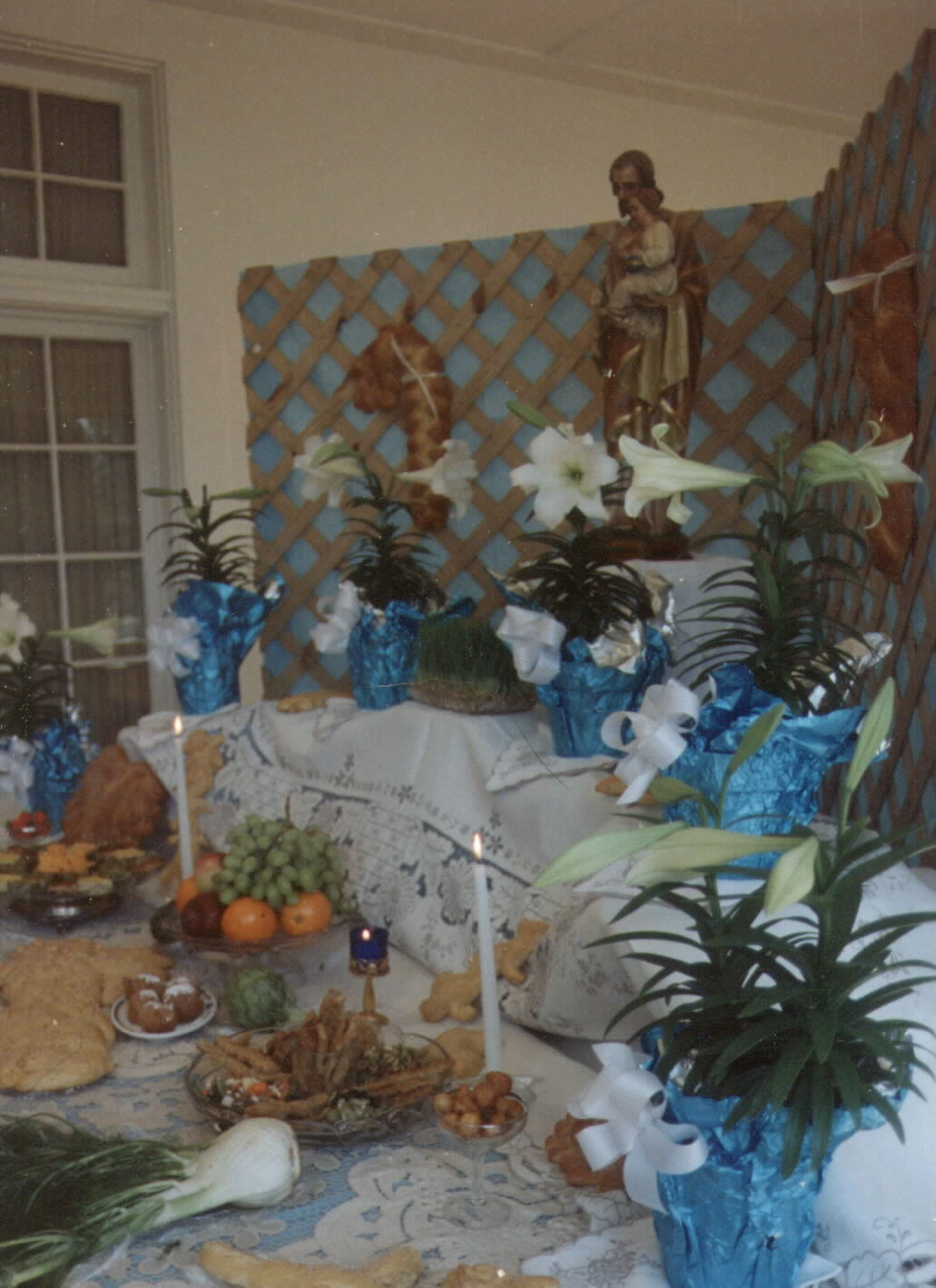
St. Joseph's Breads Castellani Art Museum,
Niagara UniversityFrom the simplest to the most elaborate altar, with a covering of the family's best table cloth candles and lilies, the image of the saint at the highest point, is the focal point for the Table. After the image of St. Joseph, bread is the most important component of the altar. Symbolic of St. Joseph, Mary and Jesus, usually the shapes and materials used in making the special St. Joseph's bread follow a fairly rigid convention.The breads are done in symbolic shapes most often in the form of a person or symbol of a saint such as a lily for Joseph or heart for Mary. The simple figure of an infant that may appear on an altar could either be a representation of the Infant Jesus or a thanksgiving for a safe delivery of a child. Breads are also in the form of St. Joseph's Beard, St. Joseph's purse fish, and wheat. One woman, whose cut hand refused to heal, remembers her mother making a bread in the shape of a hand to place on the altar as a petition for the healing of the hand.
. Originally the Table was done in the Sicilian community and little known outside the group. Today, the Table is being done mot only by families within the community but by restaurants, churches and social clubs. Some do it in thanksgiving for favors received, others to build community, and a few restaurants (a minority) as a commercial enterprise. The tradition though is still deeply rooted in the Sicilian community although many choose not to do it as it is a voluntary celebration. Often the cost precludes a single individual undertaking a Table so a group will do one with each person contributing time and money in thanksgiving for a personal promise.
This is very much within the tradition of the ex voto- of leaving the image of the body part which needs to be or has been cured on or near the altar of the saint to whom the petition has been made. Pots of sprouted wheat called the vorieddu (the little green) may be included. Fresh fruits and vegetables, most often grapes, artichokes and pineapples, are arranged around the statue and candles. Oranges are used in great abundance which some say are for the sweetness of St. Joseph. The long green ferny tops of fennel or finocchi are hung over the edges of the table. Plates of the food to be served at the Table are also placed on the altar. Within this general framework, each altar is unique to the place and to the person constructing it. Altars may be duplicated exactly from year to year or may change radically. One person may assume the preparation of the altar as the fulfillment of a promise to the Saint or several may share in the responsibility.
St. Joseph's Altar, Sisters of St. Joseph, Clarence NY
For a more extensive discussion of the tradition see The St. Joseph's Table
The Slava"Where there is a Serbian there is a Slava." When you celebrate your Slava at your house, you are tied to all the others who celebrate on that day, celebrating a common bond of baptism, of belief and of heritage. The Slava is the veneration of the family patron saint whose feast day it was when the family (clan) was baptized in the 9th century. Since Serbs lived in different tribes and were baptized on different days, families within a church will have different patron saints which are passed from father to son (the agnatic line). A woman adopts the Slava of her husband's family. The Slava is referred to in various ways. It may be written as "Krsna Slava"- baptismal glory; "Krsno Ime"- baptismal name; "Svetac"- saint; "Svecharstvo"- family celebration. Churches and organizations celebrate a Slava in honor of their patron saint. The Kum (Godparent of the Church) and his wife would act as host and hostess. They would take responsibility for preparing the Slava altar.
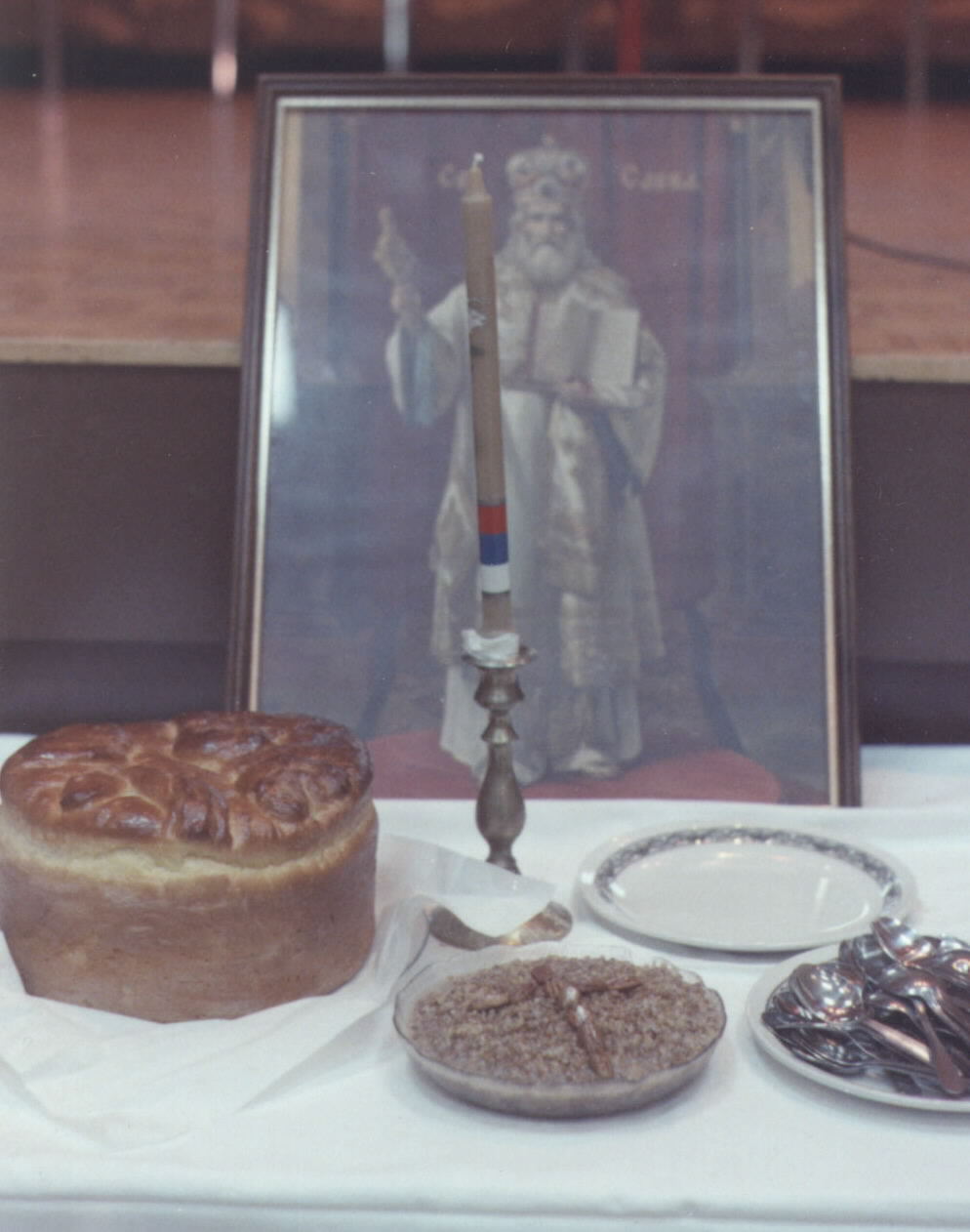
If the Slava is done correctly it will be preceded by several days of fasting and house cleaning as preparation. During that time the family prepares the elements needed for the Slava: Using a central table covered with an embroidered cloth, they place the icon of the patron saint, holy water, a bunch of fresh basil wrapped in ribbon in the Serbian colors of red, white and blue or plain red, boiled wheat (zito or kolyivo) and a dish of spoons, Slava bread (kolach), wine, a candle trimmed with wax lilies, a censer with lighted charcoal and incense and a book with the names of the family members, both living and dead.
Slava water is used by the priest to bless the house and the family. Any remaining water is used for the kolach or spilled in the garden.
Slava wheat (zito or kolyivo) is a dish of boiled wheat, powdered sugar, chopped nuts and almonds. It is relic of pagan times symbolizing the animal killed with the knife.
The zito is said to represent the Resurrection. It is prepared in the honor of the saint and members of the family who have died. It is not served at the Slava if the patron saint is considered to be still living-- Elijah, or Archangel Michael.
The Slava ritual at the altar is most often followed by a dinner of chicken soup, salad, potatoes, chicken, pork (occasionally roast lamb), vegetables and plates of cookies. If the church Slava is held in the late afternoon there may be a dance after the dinner. If the Slava is a family Slava, there may be a dinner or an open house for the family and close friends.
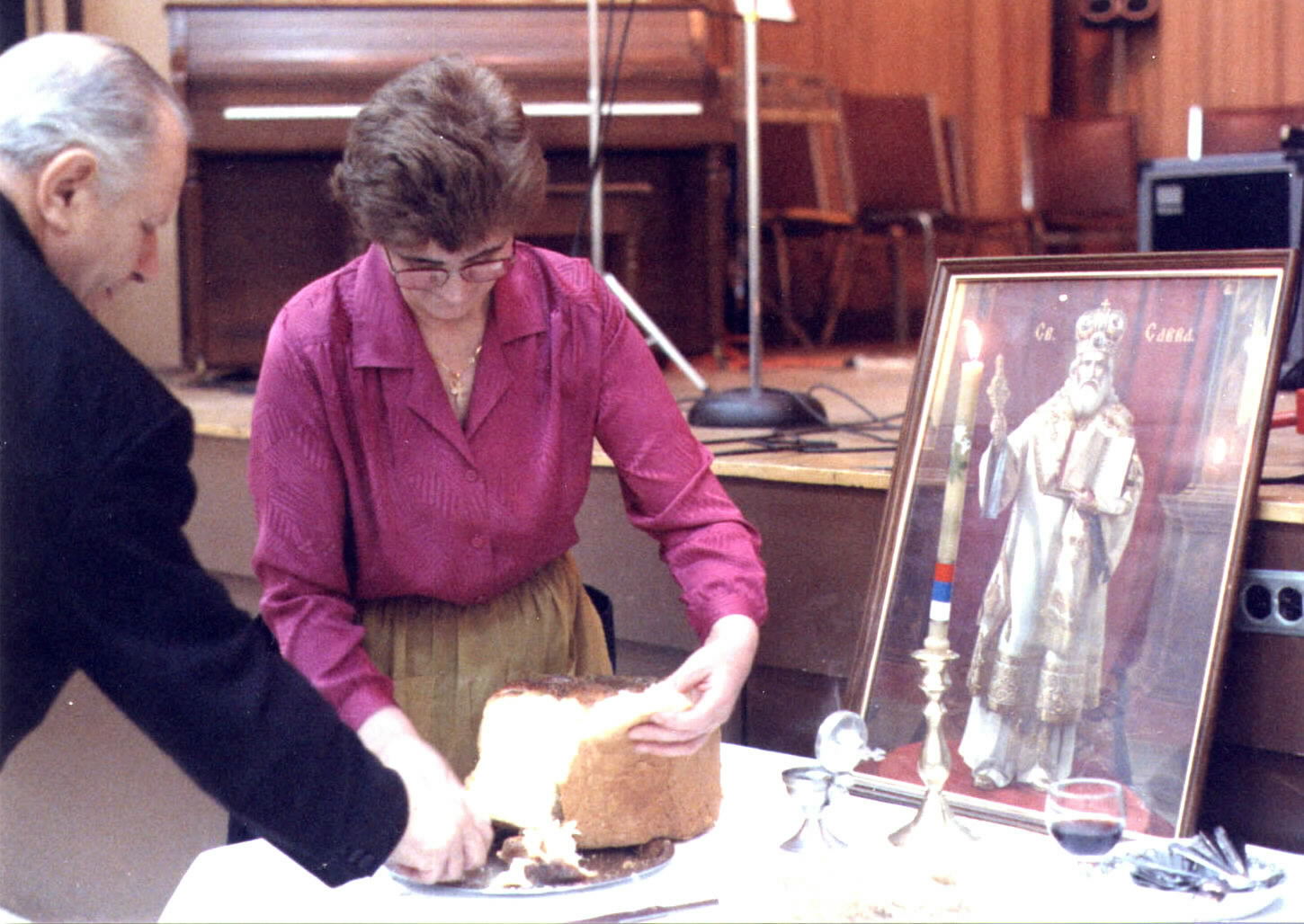
Slava bread (kolach) is baked by the woman of the house or in the case of a church slava by the "godmother" of the church. The priest (or the father if no priest is available) holds kolach to his chest and cuts a cross into the underside. Red wine is poured into the corners and center of the cross symbolizing the wounds of Christ. Those present are invited to turn the kolach. A small pamphlet on the Slava, I found at one Serbian church, points out that women must know when not to turn the kolach, kiss the cross or take communion - a very subtle reference to a menstrual prohibition (Todorovich). One source said that the prayers said while turning the kolach are said to be an invocation of fertility similar to wedding. The seal from the top is saved until the next year when it is crushed and added to the new kolach to symbolize the continuity of the Slava. After the prayers and blessing of the kolach and the people present with the water and the incense, the kolach is kissed, torn apart and served. Each person in turn venerates the icon and takes a pieces of the bread. The people will kiss the bread before eating it. They also take a bit of the cracked wheat with a spoon and eat it.
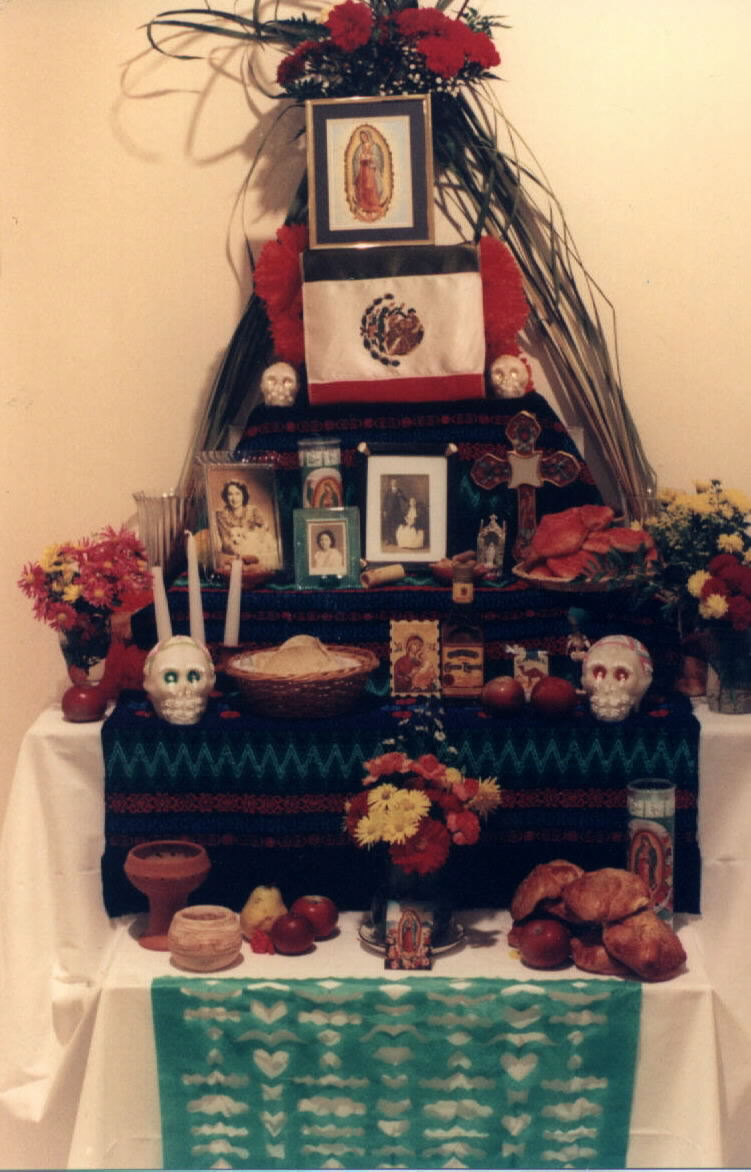
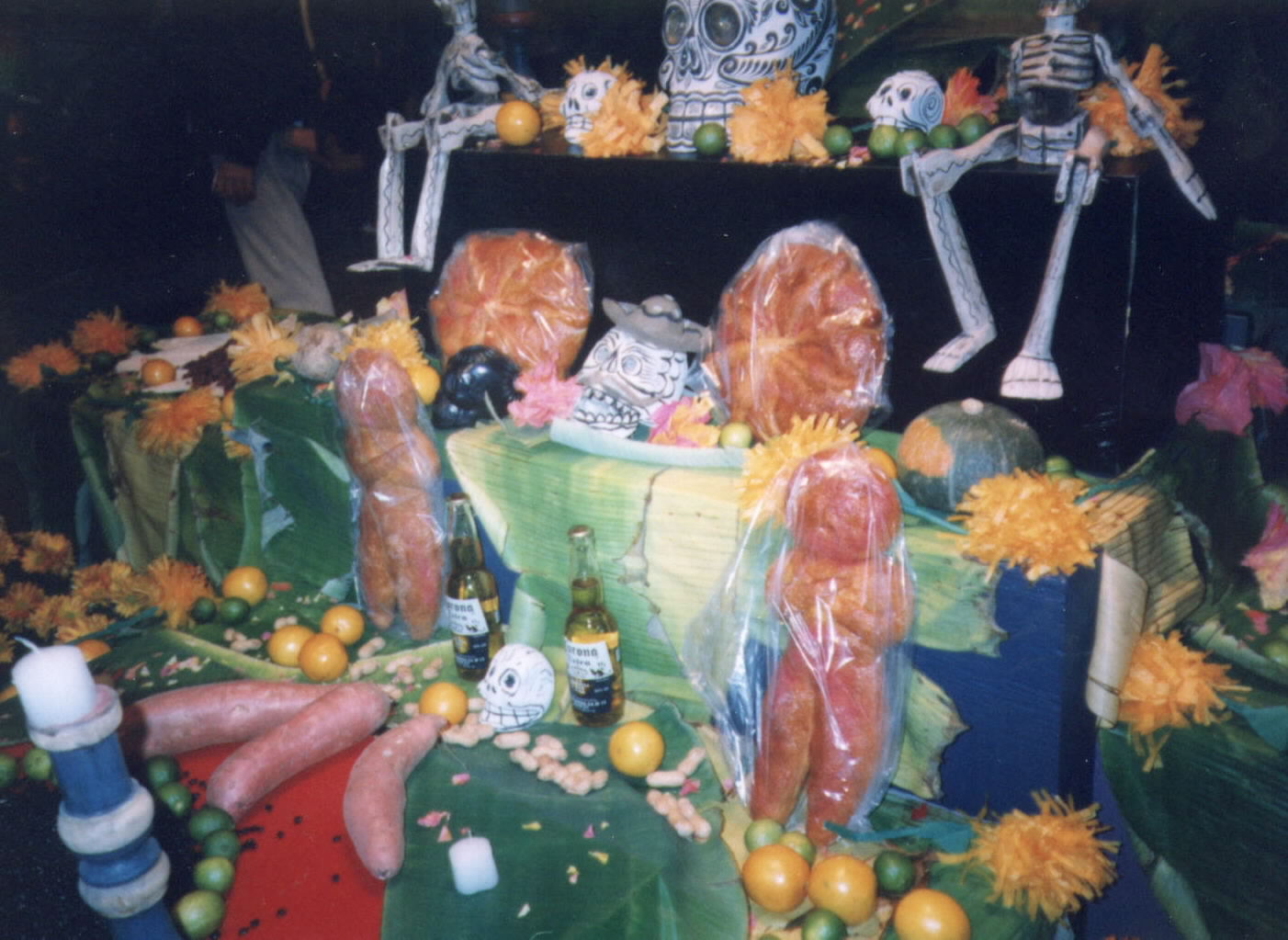
Los Dias de Los Muertos (The Day of the Dead)This celebration is a blend of celebrations by the pre-Christian indigenous people of Mexico in July presided over by the goddess Mictecacihuatl- Lady of the Dead and Christianity and a deliberate attempt by the Church to find a connection between indigenous and Christian beliefs that would aid in the conversion of the people, it was moved by the Spanish to coincide with All Hallows Eve (the evening of October 31) and continuing through November 1st - All Saints Day (Dia de Todos Santos) for those who have all the blessed that are already in heaven- the angels, Virgin Mary, the Apostles, baptized children Dias de los Angelitos - day of the little angels and the unnamed saints and November 2nd, All Souls Day (La Dia de Los Muertos) for everyone else. How it is celebrated varies from area to area but the common idea is to remember deceased relatives and friends. It is not a morbid occasion but rather a festive time. Death is only a door through which a soul passes to another state of life.These planes of existence are on different levels yet exit together. Communication between these levels is constant. The Day of the Dead is a celebration of this communication that takes place once a year when the souls are said to be the closest to the living.
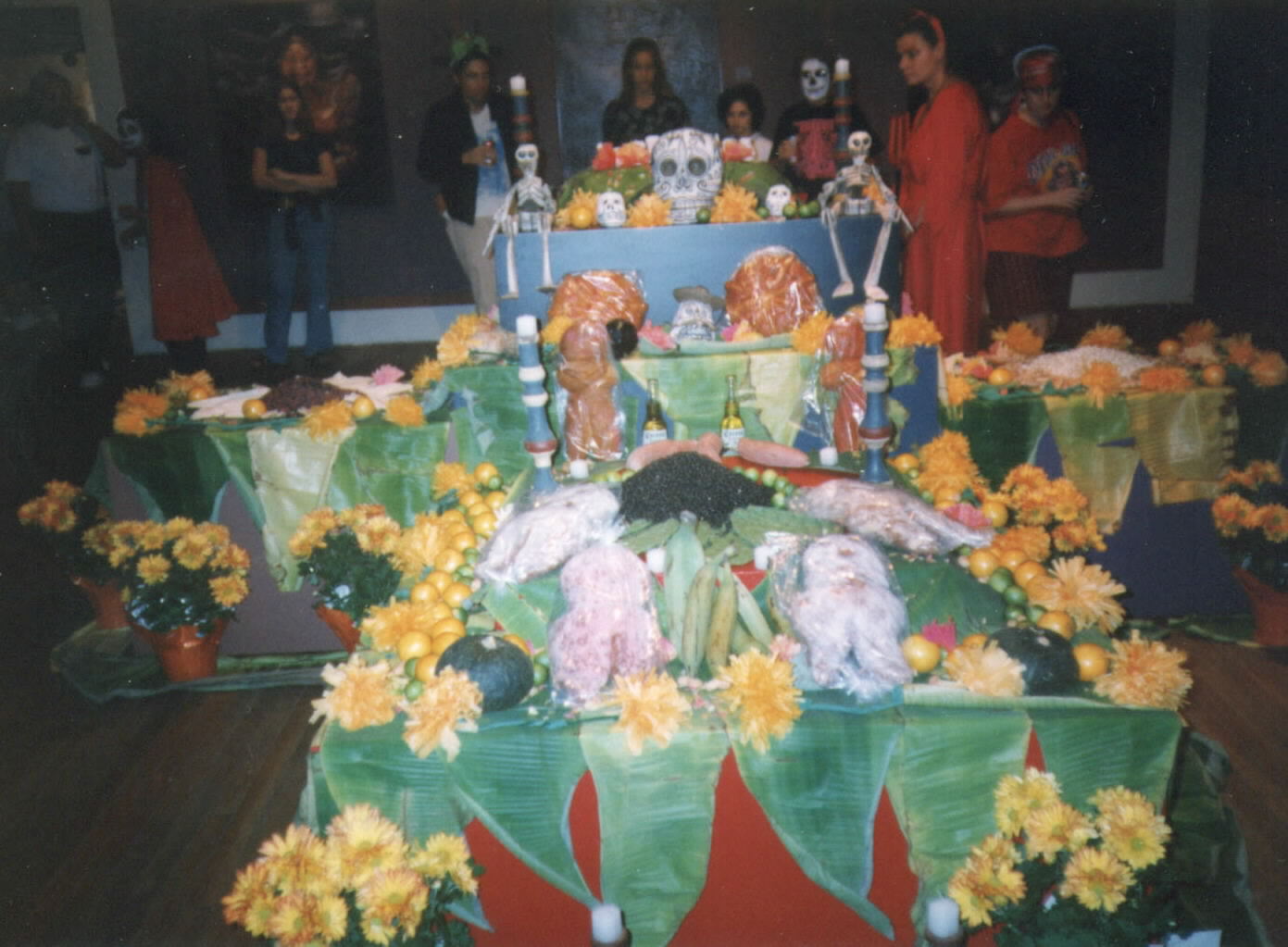
Day of the Dead Altar
MexicArt Gallery Austin Texas
1. At the cemetery
2. At homeThe people visit the cemetery to clean, decorate with flowers- usually marigolds (cempasuchitl) a symbol of spiritual solidarity and Pan de Muerto- bread of the dead which is bread is shaped into skulls or round loaves with strips of dough rolled out and attached to resemble bones and candles. After prayers are said for the spirits, the offerings (ofrendas) of their favorite foods and drink (plates of tamales, pie of corn with fillings, beverages including chocolate, tequ'fia, or mezcal; local fruit including chayotes, limes and avocados) that have been placed on the graves to lure the spirits back are eaten by the family. "The spirits can only eat and drink the essence of the food so we can eat the rest."
In homes the altar becomes the ofrenda (the offering). In this celebration the altar is the site of the encounter (the border) between the living and the dead between earth and heaven. Often the altar is just a table set along the wall but can be a special place heavily decorated with fabric, flowers- (marigolds, coxcombs, mums), papel picado (paper cutouts), alfenique— sculptures made of sugar including small animals, miniature plates of food, coffins, skeletons and the calavera— sugar skulls that have names written on them as well as plain and decorated candles and incense especially copal. It also includes most importantly a photo of the person(s) being remembered, all the objects the person used to enjoy in life: food: tortillas, beans, mole negro- meat in chile sauce, chiles, rice, pulque, blue corn atole, bread, cigarettes, books, possibly new clothes, and tools. The smell of flowers, food, incense, light from candles, sound of music of the drums and flutes all serve to draw the spirits of the dead to join the living in a celebration, not of death, but of life. It is a time of remembrance of their humanness.
Of the three celebrations under consideration, the Slava is the only one that has not moved from the family and church into public celebrations in which the wider community is invited to share the tradition. This may be because the Serbs had to celebrate the Slava secretly during the 500 years of Turkish occupation beginning in 1389. The Serb community in this area is very small and has kept to itself. I was able to observe the tradition because the Slava played a role in the life of the community my husband and I were a part of due to his teaching dance to the community's children. Family and friends are invited to attend the Slava and are offered food and drink after reverencing the icon, eating a spoonful of the zito and a piece of the kolach.
Day of the Dead Altar
Castellani Art Museum,
Niagara University NYWherever The Day of the Dead is celebrated (Mexico, Texas, or Detroit or Buffalo) the actual form may vary, with a blending of the indigenous beliefs, Christianity and contemporary Halloween customs by people who have no connection with the original form of the feast. Chicano and other galleries have begun to hold Day of the Dead celebrations with artists so that the tradition is spreading to other Hispanics and even Anglos. A Day of the Dead celebration at MexicArt Gallery in Austin two years ago included a parade of people in costume (Mexican traditional dress, saints and skeletons) along with a Mariachi band on a truck and low-riders (a type of customized car favored in the Chicano community). The parade ended at the Gallery where it was met by community members in costume. The evening program included children's activities such as mask making, dance exhibitions and music. A display of children's interpretation of skeletons was set up as well as an altar. Traditional food and drink was sold as well as pan de muerto. El Museo Oller y Diego Rivera in Buffalo has held an altar celebration open to the community-- artists, organizations, individuals who wish to honor deceased family and friends. Turner and Jasper look at this late 20th century Los Dias de Los Muertos as a reinvented tradition used to explore the notion of death and spirituality in a national milieu that is essentially uncomfortable with both." However I have seen the same phenomenon occur with the St. Joseph's Table. It has moved from being a "home-centered" fulfillment of a promise made to the saint, to a parish community, a social club, or to a restaurant. The altar, the food, the reason for doing the Table, and the hospitality remains the same but the forum changes the dynamic and opens the tradition up to the wider community.
The altar and the accompanying celebration are a periodically recurrent, social occasion in which, through a multiplicity of forms and a series of coordinated events, all members of a whole community, united by ethnic, linguistic, religious, historical bonds and sharing a world view participate directly or indirectly and to varying degrees. The altars and celebration serve as a way to educate the members of the group especially the young by including them in the preparation and execution of the celebration. Specific food is served which often is served only at this time with recipes passed from mother to daughter. Other tasks are assigned to family members on the basis of age and skill. Children may be removed from school for the day to enable them to participate. The altars validate the culture to the group by providing the people a specific time and place to tell the family and group story. Families and friends often come from distant places to be together. The consistent way in which the celebration is carried out ensures adherence to cultural norms. People have said that participating in an altar celebration be it the St. Joseph's Table, the Slava or the Day of the Dead makes them feel a part of the group which in today's increasingly fragmented society is important. There is a tie to the group which is very difficult for people outside the group unless they are a part of a group with similar traditions. The more I work with the people and the traditions, the more aware I've become of the complexity of the meanings in them. Folk religious practices will not disappear or change their basic premises. This leads to a sense of "Cultural Citizenship" which is the right to be different in terms of race, ethnicity or native language with respect to the norms of the dominant national community without compromising one's right to belong, in the sense of participating in the political and economic life of the dominant culture. Cultural citizenship refers to the way people organize their values, their beliefs about their rights, and their practices based on their sense of cultural belonging rather than their formal status as citizens of a nation. In this case it is the strength of their religious beliefs that gives them identity.
BibliographyAlba, Richard. Ethnic Identity. New Haven: Yale University Press, 1990.Bascom, William R. "Four Functions of Folklore." Journal of American Folklore 67 (1954): 333-49.
Beimler, Rosalind Rostoff and John Greenleigh. The Days of the Dead. San Francisco: Pomegranate, 1998.
Berger, Pamela. The Goddess Obscured: The Transformation of the Grain Protectress from Goddess to a Saint. Boston: Beacon Press, 1985.
Brandes, Stanley. "The Day of the Dead, Halloween, and Mexican National Identity." Journal of American Folklore 111.442 (Fall 1998) 359-391.
Bromley, Yu V. "On the Typology of Ethnic Communities". Perspectives on Ethnicity. Ed. Regina Holoman, & Serghei A.Arutiunov. The Hague: Mouton Publishers 1978
Camporesi, Piero. The Magic Harvest: Food, Folklore and Society. Cambridge: Polity Press, 1993.
Carmichael, Elizabeth and Chloë Sayer. The Skeleton at the Feast: The Day of the Dead in Mexico. Austin: University of Texas Press, 1997.
Degh, Linda, ed. Studies in East European Folklore. Indiana University Folklore Institute Monograph Series 25. Bloomington Indiana: Indiana University Folklore Institute, 1978.
Della-Casa, Nicoletta. "Sardinian Ceremonial Bread." Folklore 95.1 (1984): 30-37.
diLeonardo, Micaela. The Varieties of Ethnic Experience: Kinship, Class and Gender Among California Italian-Americans. Ithaca: Cornell University Press, 1984.
Field, Carol. The Italian Baker. NY: Harper & Row, 1985.
Flores, William V. and Rina Benmayer, ed. Latino Cultural Citizenship: Claiming Identity, Space and Rights. Boston: Beacon Press, 1997.
Galanti, Elizabeth. "Per Gracia Ricevuta: Aspects of Italian Ex Voto." International Folklore Review: Folklore Studies from Overseas 6 (1988): 78-88.
Garcigodoy, Juanita. Digging the Days of the Dead. Niwot Colorado: The University of Colorado Press, 1998.
Gonzalez-Crussi, Frank. Day of the Dead and Other Mortal Reflections. NY: Harcourt Brace & Company, 1993.
Halpern, Joel. A Serbian Village. NY: Harper and Row, 1954.
Halpern, Joel and Barbara Kerewsky-Halpern. A Serbian Village in Historical Perspective. Case Studies in Cultural Anthropology, Stanford University. NY: Irvington Publishers, Inc, 1972.
Jansen, William Hugh. "The Esoteric-Exoteric Factor in Folklore." Fabula: The Journal of Folklore Studies 2 (1959): 205-11.
Kerelewsky-Halpern, Barbara and Joel Halpern, ed. Selected Papers on a Serbian Village: Social Structure As Reflected by History, Demography and Oral Traditon. Amherst MA: University of Massachusetts, Department of Anthropology.
Low, D.H. The Ballads of Marko Kroljevic. NY: Greenwood Press Publishers, 1968.
Mitchell, Nathan. Cult and Controversy: The Worship of the Eucharist Outside Mass. NY: Pueblo Publishing Co, 1982.
Paz, Octavio. The Labyrinth of Solitude and Other Writings. NY: Grove Press, 1961.
Ramet, Pedro. Ed. Religion and Nationalism in Soviet and East European Politics. Durham NC: Duke Press Policy Studies, 1984.
Root, Waverly. The Food of Italy. NY: Vintage Books, 1992.
Sommers, Laurie Kay. Fiesta, Fe, Y Cultura: Celebrations of Faith and Culture in Detroit's Colonia Mexicana. East Lansing: Michigan State University Museum, 1995.
Stern, Steven and John Allan Cicala, ed. Creative Ethnicity: Symbols and Strategies of Contemporary Ethnic Life. Logan Utah: Utah State University Press.1991
Streep, Peg. Altars Made Easy: A Complete Guide for Creating Your Own Sacred Space. NY: HarperSanFrancisco, 1997.
Todorovich, The Very Rev. Fr. Marko B. Slava & Chitulja. The Clergy Brotherhood of the Serbian Orthodox Free Diocese for the United States and Canada.nd.
Trenchard, Kathleen. Mexican Papercutting. Ashville NC: Lark Books, 1998.
Turner, Kay and Pat Jasper. "Day of the Dead: The Tex-Mex Tradition." Halloween and Other Festivals of Death and Life. Jack Santino. Knoxville: University of Tennessee Press, 1994.
Waters, Mary C. Ethnic Options: Choosing Identities in America. Berkeley: University of California Press, 1990.
West, John O. Mexican-American Folklore. Little Rock: August House Publishers, 1988.
Yoder, Don. "Toward a Definition of Folk Religion." Discovering American Folklife: Studies in Ethnic, Religious and Regional Cultures. Don Yoder. Ann Arbor MI: UMI Research Press, 1990. 67- 84.
[top of page]